
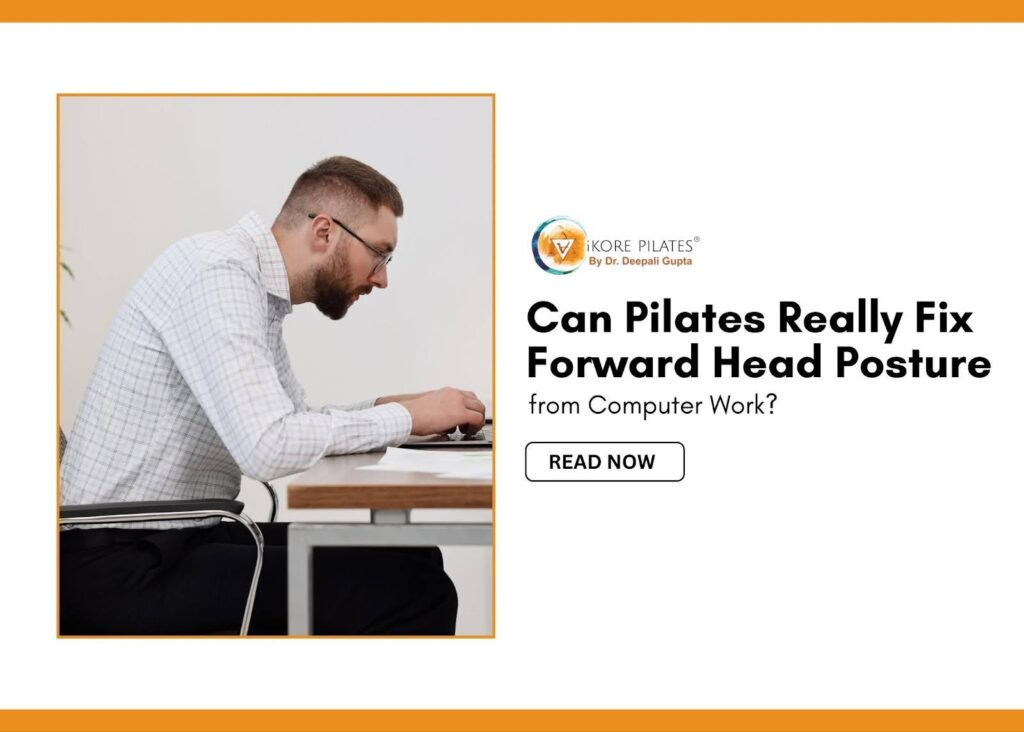
Spending 8+ hours hunched over a laptop takes a toll on your neck. Forward head posture, often called “tech neck,” occurs when your head juts forward beyond your shoulders, straining muscles and compressing cervical vertebrae. According to research published in the Journal of Physical Therapy Science, for every inch your head moves forward, it adds 10 pounds of pressure on your spine.
Pilates offers a practical solution. The method targets the root cause of postural dysfunction by strengthening deep stabilizing muscles, improving body awareness, and restoring natural spinal alignment.
Why Computer Work Destroys Your Posture
Office workers face a perfect storm of postural challenges. Sitting for prolonged periods weakens your core stabilizers. Screen placement encourages your head to drift forward. Shallow breathing from stress tightens chest muscles while lengthening and weakening the muscles between your shoulder blades.
Your body adapts to what you do most often. When you hold forward head posture for hours daily, specific muscles become chronically shortened while their opposing muscles become overstretched and weak. The suboccipital muscles at the base of your skull tighten. Your deep neck flexors, which should support your head’s weight, become inhibited. Your upper trapezius compensates, creating tension headaches and shoulder pain.
Poor posture also affects your nervous system. When your head projects forward, it can compress nerves exiting the cervical spine, potentially causing tingling in your arms or hands.
How Pilates Addresses Forward Head Posture
Pilates takes a comprehensive approach to posture correction that goes beyond simple stretching or strengthening isolated muscles.
The method emphasizes axial elongation, creating length through your spine rather than compressing it. Every exercise begins with proper alignment cues. You learn to stack your head over your shoulders, ribs over pelvis, creating an efficient load-bearing structure.
Pilates retrains your deep neck flexors through controlled, precise movements. Exercises like “Neck Pull” and “Roll Up” require you to lift your head with the deep cervical flexors rather than the larger, superficial muscles you typically overuse.
The equipment at studios like iKore Pilates adds resistance that challenges your postural muscles differently than bodyweight exercises. The Reformer’s spring tension provides feedback, helping you sense when you lose neutral alignment. The Cadillac’s push-through bar assists overhead movements while maintaining cervical stability.
Breath work integrated into every exercise expands your ribcage three-dimensionally. Full breathing patterns release tight chest muscles and activate back extensors, counteracting the forward collapse common in desk workers.
Key Pilates Exercises for Tech Neck
Several foundational Pilates exercises specifically target forward head posture:
- Chin Nods: While lying on your back, gently nod your chin toward your chest without lifting your head. This isolated movement activates deep neck flexors without engaging the sternocleidomastoid muscle that tends to dominate.
- Chest Expansion: Standing or kneeling, reach your arms back while maintaining a neutral head position. The exercise strengthens rhomboids and middle trapezius while stretching pectorals, directly counteracting the rounded shoulder position.
- Swan Prep: Lying face down, lift your upper body by engaging back extensors rather than pushing with your arms. The movement strengthens the muscles that oppose forward head posture while teaching spinal extension.
- Arm Circles: Standing with weights or resistance, circle your arms while maintaining shoulder stability. The controlled movement pattern retrains scapular stabilizers to support proper shoulder position.
- Spine Stretch Forward: Sitting tall, reach forward while maintaining length through your spine. The exercise teaches you to move from your hips rather than collapsing through your mid-back and neck.
What to Expect from Regular Practice
Postural change happens gradually. Most people notice increased body awareness within 2-3 weeks of consistent practice. You’ll catch yourself slouching at your desk and have the muscular strength to self-correct.
Visible postural improvements typically emerge after 8-12 weeks of regular sessions. Your head begins sitting farther back over your shoulders. The curve at the base of your neck becomes less pronounced.
Pain reduction often happens before visible changes. Tension headaches decrease. Shoulder tightness eases. Your neck feels less stiff when you wake up.
Rehab Pilates sessions can accelerate progress for those with significant postural dysfunction or pain. One-on-one attention allows instructors to modify exercises for your specific imbalances and monitor compensation patterns you might not recognize.
Combining Pilates with Desk Setup Changes
Pilates works best alongside ergonomic adjustments to your workspace. Position your monitor at eye level, about an arm’s length away. Your gaze should land at the top third of the screen without tilting your head up or down.
Set reminders to change position every 30 minutes. Stand for calls. Take walking breaks. Your body needs movement variety, not just better posture while sitting still.
Consider Pilates 3-D virtual sessions if you work from home. Real-time corrections during private online sessions ensure you perform exercises correctly without developing compensatory patterns.
Practice micro-breaks using Pilates principles. Every hour, perform 5-10 chin nods. Roll your shoulders back. Take three full breaths, expanding your ribcage in all directions. Small, frequent corrections prevent the cumulative strain that leads to chronic forward head posture.
Beyond Exercise: The Mind-Body Connection
Pilates emphasizes concentration and control. You learn to sense where your body sits in space, called proprioception. Enhanced proprioception allows you to recognize poor posture before pain develops.
The focused attention required during Pilates practice carries into daily life. You become aware of how you hold your head while checking your phone, how you sit during meetings, and how you carry tension in your jaw and neck.
Stress management plays a role, too. Shallow breathing and muscle guarding increase when you feel anxious or overwhelmed. Pilates breathing techniques activate your parasympathetic nervous system, reducing the physiological stress response that contributes to muscle tension.
FAQs
How long does it take to fix forward head posture with Pilates?
Noticeable improvements typically appear within 8-12 weeks of practicing 2-3 times per week. Increased awareness happens sooner, often within 2-3 weeks. Severe cases or longstanding postural dysfunction may require 6+ months of consistent practice combined with ergonomic changes.
Can Pilates reverse years of poor posture?
Yes, with consistent practice. Your body continuously remodels based on the demands you place on it. Regular Pilates retrains muscular patterns, strengthens stabilizers, and restores range of motion. The process takes time, particularly if you’ve maintained forward head posture for many years, but improvement is possible at any age.
Should I do Mat Pilates or equipment sessions for posture correction?
Both offer benefits. Mat classes build foundational strength and are more accessible for regular practice. Equipment sessions at studios like iKore Pilates provide resistance and feedback that accelerate postural learning. Combining both delivers optimal results, especially when starting with private equipment sessions to establish proper form.
Will my forward head posture return if I stop doing Pilates?
Postural changes require ongoing maintenance. If you return to prolonged sitting without movement breaks or stop strengthening exercises entirely, old patterns gradually return. However, the body awareness you develop through Pilates often persists, making it easier to recognize and self-correct postural drift before it becomes problematic again.