
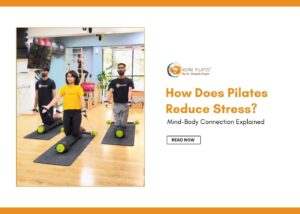
When life feels overwhelming, your body keeps score. Tension settles in your shoulders, breathing becomes shallow, and mental clarity fades. While high-intensity workouts promise stress relief, Pilates offers something different: a practice that addresses both physical symptoms and mental sources of stress through the mind-body connection.
Pilates isn’t just about building core strength. At its heart, it’s a practice of mindful movement that teaches you to reconnect with your body, regulate your nervous system, and develop lasting tools for stress management. Recent research confirms what practitioners have known for decades: Pilates significantly reduces anxiety and creates measurable improvements in mental well-being.
The Science Behind Pilates and Stress Relief
A 2025 observational study comparing people practicing Pilates once weekly for three months to inactive controls found dramatic results. Anxiety scores in the Pilates group dropped from 6.16 to 3.92, while the control group’s anxiety actually increased from 5.29 to 8.21. More impressively, participants improved their ability to benefit from spare time and “take their mind away” from daily commitments, showing that Pilates builds real-world stress resilience.
What makes Pilates uniquely effective comes down to three interconnected mechanisms: conscious breathing patterns, mindful movement practice, and body awareness. Unlike exercises that demand you push harder and go faster, Pilates asks you to slow down, pay attention, and move with intention.
How Breathing Activates Your Relaxation Response
Pilates breathing isn’t casual or automatic. Every exercise coordinates specific breath patterns with movement, typically inhaling to prepare and exhaling during exertion. You breathe deeply into your ribcage, expanding laterally rather than lifting your shoulders.
When you’re stressed, your sympathetic nervous system (fight-or-flight response) takes over. Shallow chest breathing reinforces anxiety signals. Pilates breathing activates your parasympathetic nervous system, the rest-and-digest mode that promotes relaxation, lowers heart rate, and signals safety to your brain.
Controlled, rhythmic breathing also helps regulate cortisol, your primary stress hormone. When cortisol stays chronically elevated, you experience difficulty sleeping, brain fog, weakened immune function, and increased anxiety. Regular Pilates practice interrupts this destructive cycle. Research shows that even weekly practice can reduce anxiety by 33% to 46%, with similar reductions in mental fatigue.
The Mind-Body Connection in Action
Joseph Pilates originally called his method “Contrology” because he emphasized complete coordination of body, mind, and spirit. Every movement requires your full attention. You can’t zone out during a Pilates session, and that’s precisely the point.
When you focus intently on executing a movement with proper form, breathing rhythm, and muscle engagement, you enter a state similar to moving meditation. Worries about yesterday or tomorrow fade because your attention is fully occupied with the present moment. This is the mind-body connection that makes Pilates distinct from other forms of exercise.
Studies on students show that Pilates improves attention, motivation, and cognitive function, all factors that affect how well you handle stress. The mental discipline you build during practice translates directly to stress management in everyday situations. You practice maintaining focus despite discomfort, controlling your breathing when your body wants to hold it, and moving deliberately instead of rushing.
Building Body Awareness to Release Tension
Most people carry stress physically without realizing it. Clenched jaw, raised shoulders, tight hip flexors—your body holds tension in specific patterns, and over time, these patterns become your normal baseline.
Pilates develops proprioception, your sense of where your body is in space and how it’s moving. As you learn to notice subtle differences (Am I gripping my neck? Are my shoulders creeping up?), you gain the ability to consciously release unnecessary tension.
At Ikore Pilates, instructors guide you to notice these holding patterns and teach you how to let them go. Over time, you begin catching yourself tensing up during stressful moments in daily life and can immediately soften and reset.
What Makes Pilates Different from Other Stress-Reducing Exercises
Yoga and Pilates share similarities; both emphasize breathwork and mind-body connection, but Pilates integrates more dynamic movement patterns and equipment-based resistance. Where meditation asks you to sit still with your thoughts, Pilates channels mental focus through physical challenge.
High-intensity exercise can reduce stress for some people, but it can also spike cortisol if you’re already overtaxed. Pilates offers moderate-intensity movement that’s demanding enough to require concentration but gentle enough to activate relaxation responses rather than stress responses.
The rehabilitation roots of Pilates also make it accessible when you’re depleted. You don’t need peak energy to practice. Whether you choose mat pilates or equipment-based sessions with the reformer, exercises can be scaled to match your current state.
How to Start Using Pilates for Stress Relief
You don’t need to practice daily to experience stress-reducing benefits. The research showing significant anxiety reductions was based on just one weekly session. Consistency matters more than intensity.
Begin with these practical steps:
- Start with beginner-friendly mat work. Basic exercises teach fundamental breathing and control without overwhelming you.
- Focus on your breath first. Even if the movements feel awkward initially, prioritize maintaining steady, full breathing. The physical benefits will follow.
- Notice without judging. Pilates isn’t about perfect execution. Simply observe where you hold tension, which movements feel restricted, and what your body needs.
- Consider professional guidance. Working with a certified instructor ensures you learn proper form and breathing patterns from the start. Ikore Pilates offers comprehensive training programs for those who want to deepen their practice or pursue certification.
- Give it time. While some people feel calmer after a single session, building lasting stress resilience takes weeks of consistent practice.
Ready to Experience the Stress-Relieving Benefits of Pilates?
At Ikore Pilates, we understand that stress management requires more than just physical exercise. Our certified instructors, trained under Dr. Deepali Gupta (Asia’s Pilates Ambassador), guide you through personalized sessions that address both body and mind.
Whether you’re new to Pilates or looking to deepen your practice, we offer Mat Pilates classes, Equipment Group Classes, and One-to-One Private Sessions tailored to your needs. With locations in Aundh and Hinjewadi, Pune, we’re here to help you build lasting resilience against stress.
Start your journey toward a calmer, more balanced you, one mindful breath at a time.
FAQs
Can Pilates help with anxiety disorders?
While Pilates shouldn’t replace professional mental health treatment, research shows it can be a valuable complementary approach. Studies document significant anxiety reductions even among people with elevated baseline anxiety levels.
How quickly will I notice stress relief from Pilates?
Many people report feeling calmer immediately after their first session. The deep breathing and focused movement create an instant shift in your nervous system. Building long-term stress resilience typically takes 6-12 weeks of consistent practice.
Is Pilates better than running or other cardio for stress?
Different approaches work for different people. Cardiovascular exercise releases endorphins and provides an excellent stress outlet. Pilates specifically trains your nervous system to down-regulate, teaching skills you can use in stressful moments when you can’t go for a run.
Do I need special equipment to practice Pilates for stress relief?
No. Mat Pilates requires only a comfortable surface. While specialized equipment like the Reformer offers additional benefits, the stress-reducing advantages of breathwork and mindful movement are fully accessible through mat-based practice.