
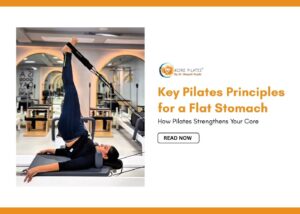
Achieving a flat stomach goes beyond endless crunches and restrictive diets. Pilates offers a scientifically backed approach to core strengthening that transforms not just how your stomach looks, but how your entire body functions. Understanding the fundamental principles behind Pilates can help you build lasting core strength while working toward that toned midsection.
Understanding the Pilates Powerhouse
Pilates targets what practitioners call the “powerhouse”, the deep core muscles that form the foundation of all movement. Unlike traditional ab workouts that focus on surface-level muscles, Pilates engages multiple muscle groups, including the transverse abdominis, multifidus, diaphragm, and pelvic floor muscles. Your transverse abdominis acts like a natural corset, stabilizing your spine from within while creating that streamlined silhouette.
The system uses approximately 50 simple, repetitive exercises designed to increase muscle strength and endurance, as well as flexibility, while improving posture and balance. What makes Pilates unique is how these exercises can be adapted to provide either gentle strength training for rehabilitation or a strenuous workout challenging enough for skilled athletes.
Whether you’re exploring Mat Pilates Classes for beginners or considering advanced training, understanding core Pilates principles accelerates your progress toward a stronger, flatter stomach.
Best Pilates Exercises for Stomach Toning
The Hundred
Lie on your back with your knees bent or legs extended at a 45-degree angle. Lift your head and shoulders slightly off the mat while reaching your arms long by your sides. Pump your arms up and down with small, controlled movements while breathing rhythmically. The Hundred builds abdominal endurance while engaging your entire core to maintain spinal stability.
Double Leg Stretch
Start on your back with your knees pulled into your chest and your head and shoulders lifted. Extend your arms and legs simultaneously, creating length through your body, then circle your arms back to hug your knees. Your core must work constantly to keep your lower back stabilized, making this excellent for strengthening the transverse abdominis.
Plank Variations
Hold a plank position on your forearms or hands, maintaining a straight line from head to heels. Planks engage your entire core, shoulders, and back. Adding variations like leg lifts or arm reaches increases the challenge and forces your obliques to work harder to maintain stability.
Roll-Up
Begin lying flat with your arms extended overhead. Slowly peel your spine off the mat one vertebra at a time, reaching toward your toes, then reverse the movement with control. Roll-ups strengthen your rectus abdominis while improving spinal articulation and flexibility.
At iKore Pilates, certified instructors guide you through these exercises with proper form, ensuring you maximize results while protecting your body from injury.
Combining Pilates with Smart Nutrition
Pilates strengthens and tones your core, but revealing those muscles requires reducing overall body fat. Even the most effective stomach exercises won’t create a flat belly if it’s hidden under excess fat. Consider these complementary strategies:
- Maintain balanced nutrition with whole foods and lean proteins
- Stay hydrated to support muscle recovery and metabolism
- Get adequate sleep for optimal hormone balance
- Manage stress, which can affect fat storage
iKore Pilates offers Diet & Nutrition consultation to help you develop a personalized eating plan that supports your core-strengthening goals.
Five Essential Pilates Principles
Concentration: Mind-Body Connection
Pilates demands your full attention on every movement. Rather than mindlessly counting repetitions, you focus on precisely how each muscle engages and releases. The principle of concentration ensures that exercises are performed with maximum efficiency and effectiveness. When performing stomach exercises, concentrating on pulling your navel toward your spine activates deeper abdominal layers that might otherwise remain dormant.
Control: Precision Over Speed
Controlled movement builds strength more effectively than rushed repetitions. Pilates emphasizes mastering your body through deliberate, precise execution. When you slow down a movement, maintaining perfect form throughout the entire range of motion, you challenge your core to work harder and longer. Control prevents momentum from taking over, keeping constant tension on your abdominal muscles.
Centering: Engaging Your Core First
Every Pilates movement begins from your center, the “powerhouse” between your lower ribs and pubic bone. This principle of centering is fundamental to all Pilates exercises. Before extending an arm or leg, you engage your core to stabilize your spine, protecting your back while ensuring your powerhouse muscles do the work during stomach exercises.
Breathing: Fueling Your Muscles
Proper breathing oxygenates your muscles and maintains core engagement throughout each exercise. Pilates uses lateral or ribcage breathing, expanding your ribcage sideways rather than letting your belly expand. Exhaling during the challenging part of an exercise helps you engage your deepest abdominal muscles more effectively, creating the foundation for a stronger, flatter stomach.
Flow: Continuous Movement
Fluid, continuous movement keeps your core engaged from start to finish. Pilates exercises transition smoothly from one to the next, maintaining constant muscle activation rather than giving your abs a break between reps. Flowing movement patterns build endurance, teaching your core to support you throughout daily activities.
How Often Should You Practice?
Consistency matters more than intensity when building core strength. Each exercise is repeated a few times, usually three to five, rarely more, so the body is constantly exposed to new muscular challenges. Practicing Pilates regularly allows your muscles to strengthen while giving them adequate recovery time.
Beginners benefit from starting with Mat Pilates Classes to learn fundamental movements and principles. As you progress, Equipment Group Classes using reformers add resistance that accelerates abdominal strengthening. The reformer’s springs create variable resistance that challenges your core throughout each exercise’s full range of motion.
For personalized attention and faster progress, Equipment Private Sessions provide one-on-one guidance from certified instructors who customize your program to your specific goals and body needs.
To learn more about how Pilates can transform your fitness journey, explore the comprehensive benefits of Pilates training.
Frequently Asked Questions
Q: Can Pilates give you a flat stomach?
Ans: Pilates strengthens and tones your core muscles, creating a flatter, more defined midsection. However, achieving a visible flat stomach requires combining Pilates with healthy eating habits to reduce overall body fat. The practice improves posture, which makes your stomach appear flatter immediately.
Q: How does Pilates differ from regular ab workouts?
Ans: Pilates works deep stabilizing muscles that traditional crunches miss, including the transverse abdominis, obliques, multifidus, and pelvic floor. While crunches primarily target surface muscles, Pilates engages your entire core system simultaneously, teaching functional strength that supports everyday activities.
Q: What makes the Pilates powerhouse so important?
Ans: The powerhouse comprises your core muscles between the ribs and pelvis, including abdominals, lower back, hips, and pelvic floor. All Pilates exercises flow from these five essentials: breathing, cervical alignment, rib and scapular stabilization, pelvic mobility, and utilizing the transverse abdominis. This integrated approach creates lasting core strength.
Q: Do I need special equipment to practice Pilates?
Ans: Mat Pilates requires only a yoga mat and optional props like resistance bands. Reformer Pilates uses specialized equipment with springs and pulleys that add resistance and support. Both formats deliver excellent core-strengthening benefits, with mat work being ideal for beginners before progressing to equipment training.
Q: Can Pilates help with back pain while strengthening my core?
Ans: Yes. Pilates was originally developed as a rehabilitation method. Strengthening your core muscles, especially the deep stabilizers, supports your spine and often reduces back pain. Proper Pilates practice emphasizes spinal alignment and controlled movement, protecting your back while building strength through precise, mindful execution.